 TCCFP
About Me
I am a researcher at the University of Minnesota working in the Forester Lab. Although I currently work with canids and mammals more generally, I am interested in all aspects of ecological interactions. Many of my clearest early memories are visiting ecosystems besides the one I grew up in in rural southern Michigan and seeing new birds, mammals or insects, or catching strange fish in new waters. From an early age, I remember asking myself questions about why I find species in certain places and not others. I find that basic question driving my interests to this day, across spatial scales and over time. How species interactions and human activities drive the fine-scale distribution of mammals has been my most recent exploration of this topic, though many more questions interest me deeply.
On top of my research interests, a related passion is nature photography. Check out the photography tab on the navigation bar above to see some of my work!
My Research
Pleistocene mammals watched over generations as North American ice sheets receded at a glacial pace. Even in a world of change through freeze and thaw, nothing could have prepared them for the changes that affect their lives today. Over the last few generations of their lineage, the pace of change has quickened. They have seen jets scream overhead, and speed has literally been the death of millions of them on the expressways that cut across lands that previously knew no such hazards.
Some animals have not done well in this Anthropocene age, and they righfully receive most conservation attention. I do, however, find myself drawn to those who are thriving—like coyotes. Coyotes were likely urban dwellers alongside the Aztecs long before their current infamy as an urban tolerator. Despite Europeans’ best efforts to erradicate them through poisoning campaigns and bounties, they spread from their historic home in the western U.S. to every corner of the North American continent—including many cities.
Not only am I fascinated by these species that tolerate the stessors of the modern age, they are set to inherit and shape the ecosystems of the future as movers and shakers. They may be the ones to tip vulnerable prey or competitors over the edge. Understanding what makes these animals resilient animals tick is essential to understanding the ecosystems of the 21st century and beyond.
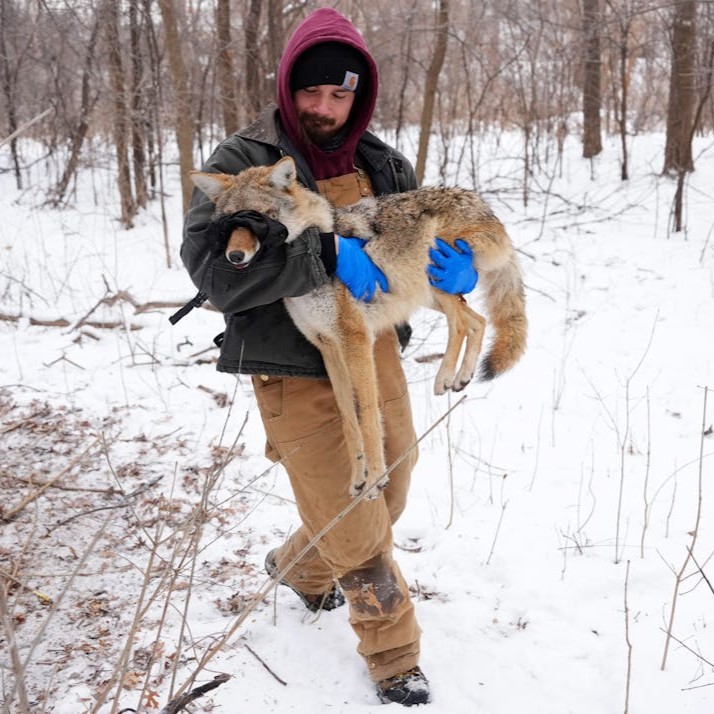
My primary work has been working with coyotes and red foxes across the Twin Cities Metropolitan Area to understand how humans affect the interactions between these two species. Coyotes dominate green spaces in this study area, seemingly pushing red foxes to become residential specialists in a “human shield” effect. Foxes often den under sheds decks while raising their young, and will not hesitate to alert the local human if coyotes are seen anywhere nearby.
However, my interst in coyotes is not limited to this system. I have also worked to model their effects on other small canids at a seemingly expanding front of their distribution: South America. Coyotes may make moves into the continent in the next few decades, and it would be prescient to know what their impacts may be.
I am open to collaborations of all shapes and sizes. Reach out by email, I would be happy to chat about coyotes or any other intersection with my interest in the species of tomorrow’s ecosystems.