 TCCFP
TCCFP Sitemap
A list of all the posts and pages found on the site. For you robots out there, there is an XML version available for digesting as well.
Pages
Posts
Kicking off my website
Published:
portfolio
publications
Mapping habitat use and disease of urban carnivores
Published in University of Minnesota, 2022
Project report for the Twin Cities Coyote and Fox Project.
Recommended citation: McCann, N. P., Miller, G. D., Forester, J. D., Craft, M. E., & Worsley-Tonks, K. E. L. (2022). "Mapping habitat use and disease of urban carnivores." Department of Fisheries, Wildlife and Conservation Biology, and Department of Ecology, Evolution and Behavior, University of Minnesota, St. Paul, Minnesota.
Download Paper
Artificial light at night increases the nighttime feeding of monarch butterfly caterpillars without affecting host plant quality
Published in Basic and Applied Ecology, 2023
Monarch caterpillars exposed to artificial light at night fed more at night, while their milkweed host plants were unaffected.
Recommended citation: Haynes, K. J., Miller, G. D., Serrano-Perez, M. C., Hey, M. H., & Emer, L. K. (2023). "Artificial light at night increases the nighttime feeding of monarch butterfly caterpillars without affecting host plant quality." Basic and Applied Ecology, 72, 10–15.
Download Paper
SNAPSHOT USA 2019–2023: The first five years of data from a coordinated camera trap survey of the United States
Published in Global Ecology and Biogeography, 2025
Five years of data from a nationwide, coordinated camera-trap survey of mammals across the United States.
Recommended citation: Rooney, B., … Miller, G. D., … McShea, W. J. (2025). "SNAPSHOT USA 2019–2023: The first five years of data from a coordinated camera trap survey of the United States." Global Ecology and Biogeography, 34(1), e13941.
Download Paper
talks
Artificial light at night alters feeding behavior of a diurnal caterpillar via effects on host-plant quality
Published:
We investigated potential indirect effects of artificial light at night on diurnal herbivorous insects via effects on host-plant quality. In a series of experiments, we tested the hypothesis that ALAN-induced changes in the growth, nutritional quality or defenses of common milkweed (Asclepias syriaca) would affect the host-plant preferences, feeding frequency, and performance of a diurnal caterpillar, the monarch butterfly (Danaus plexippus). We also tested whether ALAN has direct effects on the feeding frequency or performance of this diurnal herbivore. There was no evidence that ALAN affected the growth, nutritional quality or defensive capabilities of common milkweed, nor were there indirect effects of ALAN on caterpillar preference or performance via effects of ALAN on common milkweed. However, monarch caterpillars directly exposed to ALAN exhibited 58% higher feeding frequency at night and showed a marginally significant 10% increase in pupal mass.
A (prairie) wolf at the door: What are the consequences for South American canids if coyotes shoot the Darién Gap?
Published:
The coyote (Canis latrans) has greatly expanded its range in the past century, with expansion southward taking the species to the southern border of Panama and the doorstep of South America. The Darién Gap is a relatively intact swath of rainforest between coyotes and the South American continent. If coyotes disperse through the Darién Gap, they could have diverse effects on South American ecosystems, particularly on the endemic canid assemblage. Given the high levels of intraguild aggression among canid species, the establishment of a novel, relatively large, and more social canid species in South America could have marked effects on endemic canids. Utilizing coyote occurrence data from the GBIF database, we use a MaxEnt niche modeling approach with climatic and forest cover predictors to model the potential overlap of coyotes with native species based on published range extents of those species. We then incorporate forest-cover change to predict the effects of deforestation on habitat suitability for coyotes.
Who’s the top dog? Movement analyses suggest humans facilitate spatial partitioning in competing urban canids
Published:
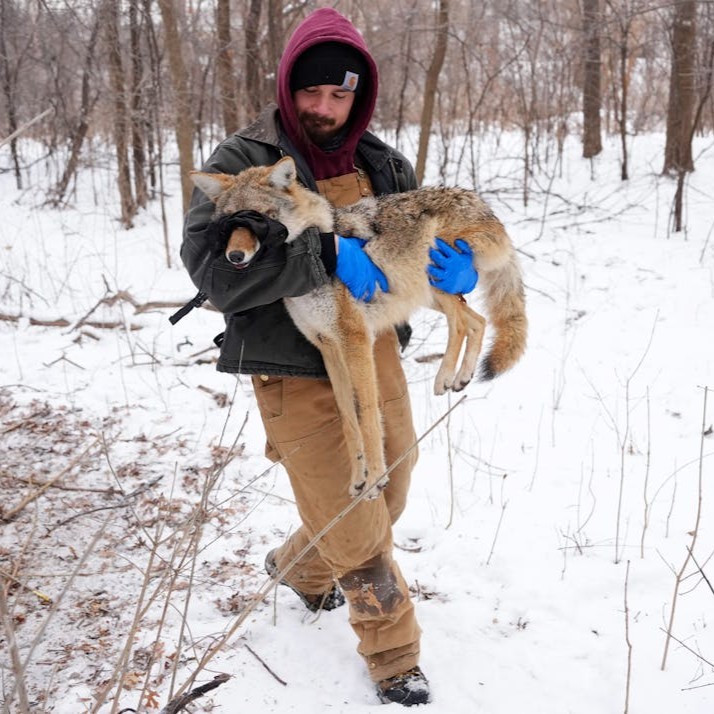
Urban landscapes present novel scenarios for wildlife to navigate, with much of the novelty arising from both the alteration of landscapes to serve human use cases and direct use of natural areas for recreation. To examine how human activity in urban landscapes affects the movement behaviors of multiple carnivores in an urban system, we GPS-collared 17 coyotes (Canis latrans) and 16 red foxes (Vulpes vulpes) in the Twin Cities Metropolitan Area (TCMA) of Minnesota between 2019–2024. To assess habitat selection patterns of individual animals, we fit resource selection functions (RSFs) with various covariates to determine second-order habitat selection (i.e., selection of territories), and step-selection functions (SSFs) to assess third-order habitat selection within home ranges. Across all seasons, coyotes established home ranges in areas of relatively low development (i.e., with lower relative road density), while red foxes were found to inhabit home ranges with more residential zoning and higher road density. However, within their home ranges, both species showed selection for areas of the landscape associated with relatively lower human use. Increases in the most urban-dwelling coyotes’ selection for non-residential areas and wetlands in the spring highlight the importance of urban wetlands for mitigating risk of human–wildlife conflict during the pup-rearing season. While coyotes occupied mainly larger greenspaces or networks of greenspaces, red foxes often selected areas with smaller green spaces within residential areas. Differences in where coyotes and red foxes choose to establish home ranges and what parts of those home ranges they display highest selection for suggests that minimizing the likelihood of encountering coyotes may be a primary driver of habitat suitability for red foxes. Furthermore, availability of residential areas is likely one of the most important factors allowing for the coexistence of coyotes and red foxes in the TCMA.
The residential shield: Tradeoffs in urban red fox selection across spatial scales suggest a human shield from coyotes
Published:
Risks posed by predators can create a “landscape of fear,” which occurs when animals change their space use and activity patterns in response to perceived predation risk. When predators respond to an anthropogenic landscape of fear, species affected by that predator may preferentially use areas with high human use and activity in a phenomenon referred to as a “human shield effect.” Coyotes (Canis latrans) pose a mortality risk to red foxes (Vulpes vulpes), which should theoretically avoid coyotes either spatially or temporally to reduce this risk if a human shield is occurring. To test whether red foxes living alongside coyotes in urban landscapes benefit from a human shield effect, we analyzed how human recreational activity and development at multiple scales affected the movement and activity patterns of 31 coyotes and 27 red foxes in the Twin Cities Metropolitan Area of Minnesota, USA, using second- and third-order resource selection functions. Our results indicate that red foxes and coyotes primarily diverge in their use of urban landscapes through selection of territories with high and low residential zoning, respectively. Both species’ use of landscapes within their territories and high nocturnality indicate human use and temporal activity are primary drivers of spatiotemporal activity at that scale. These results indicate a tradeoff in red fox use of urban landscapes across orders of resource selection, supporting the hypothesis that they select territories in proximity to human residences as a shield from coyotes which dominate spaces with lower human footprint.
teaching
Undergraduate teaching assistant
Teaching Assistant, Goshen College, 2017
General Chemistry II, Spring 2018
Organismal Biology, Spring 2018
Introductory Chemistry, Fall 2017
Vertebrate Field Methods
Teaching Assistant, University of Minnesota, 2021
Mammalogy
Teaching Assistant, University of Minnesota, 2022
Guest lectures
Guest lecturer, Universities and colleges in Minnesota and South Dakota, 2025
Guest lectures on urban carnivore ecology, wildlife field methods, and spatial analysis.