Portfolio item number 1
Short description of portfolio item number 1
Short description of portfolio item number 1
Short description of portfolio item number 2
Published in Journal 1, 2009
This paper is about the number 1. The number 2 is left for future work.
Recommended citation: Your Name, You. (2009). "Paper Title Number 1." Journal 1. 1(1).
Download Paper | Download Slides | Download Bibtex
Published in Journal 1, 2010
This paper is about the number 2. The number 3 is left for future work.
Recommended citation: Your Name, You. (2010). "Paper Title Number 2." Journal 1. 1(2).
Download Paper | Download Slides
Published in Journal 1, 2015
This paper is about the number 3. The number 4 is left for future work.
Recommended citation: Your Name, You. (2015). "Paper Title Number 3." Journal 1. 1(3).
Download Paper | Download Slides
Published in GitHub Journal of Bugs, 2024
This paper is about fixing template issue #693.
Recommended citation: Your Name, You. (2024). "Paper Title Number 3." GitHub Journal of Bugs. 1(3).
Download Paper
Published in GitHub Journal of Bugs, 2024
This paper is about a famous math equation, \(E=mc^2\)
Recommended citation: Your Name, You. (2024). "Paper Title Number 3." GitHub Journal of Bugs. 1(3).
Download Paper
Published:
This is a description of your talk, which is a markdown file that can be all markdown-ified like any other post. Yay markdown!
Published:
This is a description of your conference proceedings talk, note the different field in type. You can put anything in this field.
Published:
We investigated potential indirect effects of artificial light at night on diurnal herbivorous insects via effects on host-plant quality. In a series of experiments, we tested the hypothesis that ALAN-induced changes in the growth, nutritional quality or defenses of common milkweed (Asclepias syriaca) would affect the host-plant preferences, feeding frequency, and performance of a diurnal caterpillar, the monarch butterfly (Danaus plexippus). We also tested whether ALAN has direct effects on the feeding frequency or performance of this diurnal herbivore. There was no evidence that ALAN affected the growth, nutritional quality or defensive capabilities of common milkweed, nor were there indirect effects of ALAN on caterpillar preference or performance via effects of ALAN on common milkweed. However, monarch caterpillars directly exposed to ALAN exhibited 58% higher feeding frequency at night and showed a marginally significant 10% increase in pupal mass.
Published:
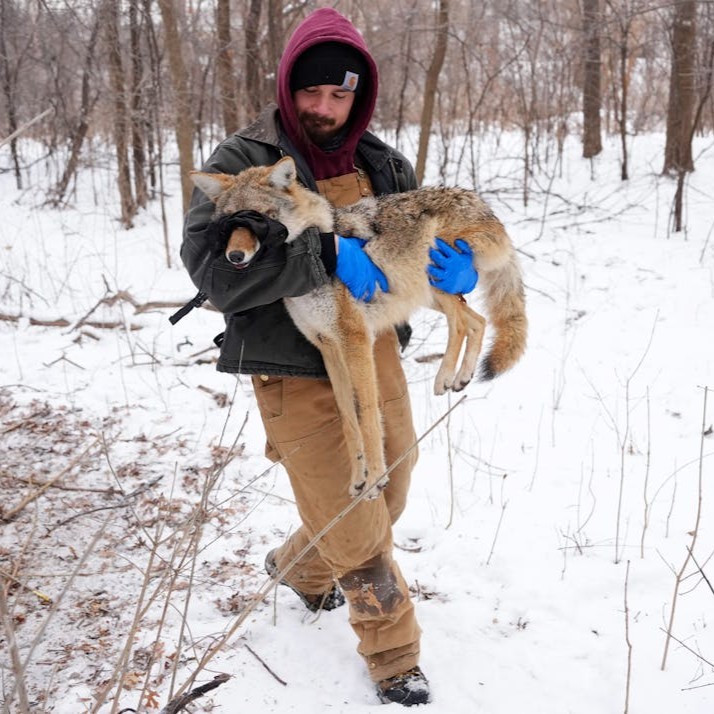
The coyote (Canis latrans) has greatly expanded its range in the past century, with expansion southward taking the species to the southern border of Panama and the doorstep of South America. The Darién Gap is a relatively intact swath of rainforest between coyotes and the South American continent. If coyotes disperse through the Darién Gap, they could have diverse effects on South American ecosystems, particularly on the endemic canid assemblage. Given the high levels of intraguild aggression among canid species, the establishment of a novel, relatively large, and more social canid species in South America could have marked effects on endemic canids. Utilizing coyote occurrence data from the GBIF database, we use a MaxEnt niche modeling approach with climatic and forest cover predictors to model the potential overlap of coyotes with native species based on published range extents of those species. We then incorporate forest-cover change to predict the effects of deforestation on habitat suitability for coyotes.
Undergraduate course, University 1, Department, 2014
This is a description of a teaching experience. You can use markdown like any other post.
Workshop, University 1, Department, 2015
This is a description of a teaching experience. You can use markdown like any other post.